
India–UK FTA: New Opportunities for Indian Exporters, MSMEs and Service Businesses

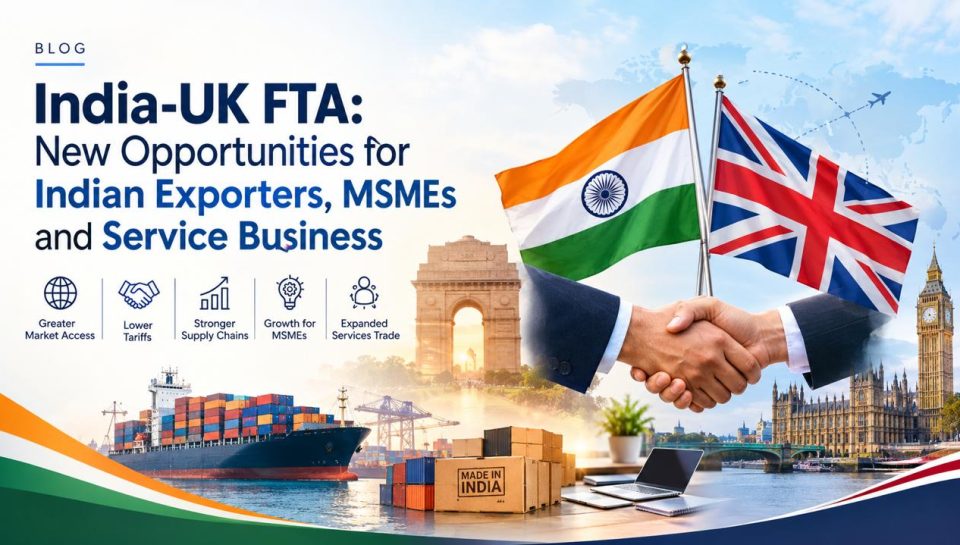
The India–UK Free Trade Agreement (FTA) marks an important new phase in economic relations between the two countries. The agreement, formally known as the India–UK Comprehensive Economic and Trade Agreement (CETA), entered into force on 15 July 2026, creating a stronger framework for trade in goods and services, customs facilitation, small and medium-sized enterprises (SMEs), rules of origin and business mobility.
For Indian exporters, MSMEs and service businesses, the opportunity goes beyond lower tariffs. The agreement can help Indian companies become more competitive, reach new UK customers, build partnerships and establish a stronger international presence.
India’s Ministry of Commerce states that the agreement provides duty-free access to almost 99% of India’s exports to the UK, covering nearly 100% of export trade value. Key sectors expected to benefit include textiles, gems and jewellery, leather and footwear, chemicals, handicrafts, ceramics, auto components, machinery, pharmaceuticals and processed foods.
The bigger question for Indian businesses is therefore not simply whether they can export to the UK, but how they can use the FTA to build sustainable growth in the UK market.
What does the India–UK FTA mean for Indian businesses?
The most immediate benefit is improved market access.
Lower or zero tariffs can reduce the landed cost of eligible Indian products in the UK, potentially making them more competitive with suppliers from other markets. For MSMEs operating on relatively tight margins, even a modest reduction in import costs can influence pricing, distributor negotiations and profitability.
However, tariff savings are only one part of the opportunity.
Successful UK expansion will also depend on:
-
Product-market fit
-
UK regulatory compliance
-
Rules of origin
-
Distribution
-
Pricing
-
Branding
-
Customer acquisition
-
Logistics
-
After-sales service
The FTA should therefore be viewed as an enabler of international expansion, rather than a substitute for a market-entry strategy.
1. New opportunities for Indian exporters
Indian manufacturers across several sectors can now reassess the commercial potential of the UK.
Textiles and apparel
India’s textile ecosystem gives Indian manufacturers opportunities in garments, fabrics, home textiles, private-label production and sustainable products.
Businesses can explore relationships with UK retailers, wholesalers, fashion brands and online platforms.
Gems and jewellery
Indian jewellery manufacturers can target UK retailers, private-label brands, e-commerce customers and specialist distributors. The opportunity is not limited to commodity exports; Indian businesses can increasingly build differentiated, design-led brands.
Leather and footwear
Indian manufacturers can explore footwear, bags, accessories and private-label manufacturing for UK brands and retailers.
Engineering and auto components
Indian engineering businesses can pursue UK opportunities in auto components, precision parts, machinery and industrial products. For these sectors, quality systems, technical specifications, certifications and reliable delivery will remain critical.
Pharmaceuticals and processed foods
Indian pharmaceutical and food businesses can benefit from improved market access where applicable, although these sectors remain subject to stringent UK regulatory and product requirements.
India’s government specifically identifies pharmaceuticals and processed foods among sectors with export opportunities under the agreement.
2. Why the FTA matters for Indian MSMEs
For a large multinational, international expansion may involve dedicated teams for legal, compliance, logistics and business development.
For an MSME, these functions can represent a significant barrier.
The India–UK CETA contains a dedicated Small and Medium-Sized Enterprises chapter, which includes provisions aimed at improving transparency, information-sharing and cooperation so that SMEs can better understand and navigate the two markets.
This can be particularly valuable for Indian businesses taking their first steps into the UK.
An MSME should nevertheless approach expansion systematically.
Before exporting, it should understand:
-
Who its UK customer is
-
What competing products are available
-
What price the market will support
-
What regulations apply
-
Which distributor or sales channel is appropriate
-
What the total landed cost will be
-
Whether its product qualifies for preferential tariff treatment
The FTA can improve the environment for internationalisation, but the business still needs a commercially viable proposition.
3. Rules of origin will be critical
One of the most important aspects of the agreement for exporters is the rules of origin.
Preferential tariffs are generally available only when goods satisfy the applicable origin requirements. A product being shipped from India does not, by itself, automatically mean it qualifies for an FTA preference.
Indian exporters therefore need to understand:
-
The correct HS classification of their product.
-
The product-specific rule of origin.
-
The origin of imported raw materials and components.
-
Required documentation and records.
-
How the origin declaration or other evidence should be prepared.
For manufacturers with complex international supply chains, this makes trade compliance an important part of export strategy.
4. Customs facilitation can support smoother trade
The agreement also includes provisions covering customs and trade facilitation.
The UK government states that the two countries will work towards transparent and efficient customs procedures, including efforts to release compliant goods within 48 hours where no physical examination is required. The agreement also provides for simplified procedures for eligible traders and greater access to customs information.
For Indian businesses, better customs processes can support more predictable supply chains.
This can matter particularly for:
-
E-commerce businesses
-
Fashion companies
-
Time-sensitive products
-
B2B manufacturers
-
Businesses using just-in-time inventory
5. A major opportunity for Indian service businesses
The India–UK opportunity is not limited to physical exports.
India has a strong competitive position in services, including:
-
IT and software
-
AI and data services
-
Engineering
-
Consulting
-
Accounting and finance
-
Business-process services
-
Design
-
Digital marketing
-
Research and analytics
-
Education and training
The India–UK agreement contains a dedicated trade-in-services chapter, alongside provisions concerning the temporary movement of certain business persons.
This creates opportunities for Indian service businesses to deepen their relationships with UK clients.
A technology company, for example, could move from purely offshore delivery towards a model combining:
Indian delivery centre + UK sales presence + cross-border specialist teams.
This can allow the company to maintain India’s talent and delivery advantages while developing stronger relationships with UK customers.
6. Business mobility can support cross-border projects
Many international service contracts require people to travel temporarily.
Consultants may need to attend client meetings. Engineers may need to work at project locations. Technology specialists may need to support implementation.
The agreement contains commitments covering certain categories of business persons and temporary movement of service providers, subject to applicable conditions.
This does not create unrestricted UK work rights or eliminate immigration requirements. Businesses and professionals must still meet the relevant visa, eligibility and contractual conditions.
For eligible businesses, however, clearer arrangements for temporary business activity can make international project delivery easier to plan.
7. E-commerce gives MSMEs another route into the UK
Indian businesses no longer necessarily need a large distributor before testing UK demand.
Digital channels can allow brands to start with a focused customer segment and scale gradually.
Potential routes include:
-
Direct-to-consumer websites
-
Online marketplaces
-
Specialist retailers
-
Social-commerce channels
-
UK fulfilment partners
-
Subscription models
This can be particularly relevant to Indian brands selling jewellery, fashion, home décor, specialty foods, handicrafts and lifestyle products.
However, online selling does not remove UK requirements relating to consumer protection, product safety, labelling, taxation, data protection and other applicable regulations.
8. From exporting products to building UK brands
One of the biggest opportunities for Indian businesses is to move up the value chain.
Traditionally, an Indian manufacturer might operate through:
Indian manufacturer → UK importer → retailer → consumer
With greater market access and digital capabilities, businesses can explore:
Indian manufacturer/brand → UK customer
The second model can provide greater control over branding, pricing, customer relationships and product positioning.
For ambitious MSMEs, the long-term objective should therefore not necessarily be to maximise shipments alone.
It should be to build recognition, recurring customers and a sustainable UK business.
9. The UK can become a strategic international base
For some Indian businesses, the UK can also become more than an export destination.
A UK presence could support:
-
Local sales
-
Distribution
-
Warehousing
-
Customer service
-
Business partnerships
-
International brand building
-
Investment relationships
-
Professional-services delivery
An Indian company might begin with exports, then appoint a distributor, establish local warehousing and eventually create a UK subsidiary.
The right model will depend on the company’s sector, customers, scale and long-term objectives.
A practical UK market-entry roadmap
Indian businesses considering the UK market can follow a structured approach:
1. Identify the opportunity
Define your ideal UK customer, competitors, price point and value proposition.
2. Assess the FTA benefit
Check the applicable tariff, HS classification and rules of origin for your specific product.
3. Calculate landed economics
Consider manufacturing, freight, insurance, duties, taxes, warehousing, distributor margins, marketing and returns.
4. Check compliance
Review UK requirements covering product standards, safety, labelling, packaging, taxation and sector-specific regulations.
5. Choose an entry channel
Consider distributors, importers, retailers, marketplaces, direct-to-consumer sales or a UK subsidiary.
6. Start with a pilot
Rather than attempting to cover the entire UK, begin with one product, one customer segment and one channel.
7. Scale what works
Once demand and margins are validated, expand products, customers, distribution and local capabilities.
What Indian businesses should avoid
The FTA creates opportunity, but businesses should avoid assuming that market access automatically means market success.
Common mistakes include:
-
Assuming zero duty means zero cost
-
Ignoring rules of origin
-
Selecting distributors without adequate due diligence
-
Competing only on price
-
Underestimating UK compliance requirements
-
Treating the UK as a single homogeneous market
-
Scaling before testing customer demand
The businesses most likely to build sustainable UK operations will be those that combine FTA advantages with strong products, compliance, customer understanding and disciplined execution.
Conclusion: Turning the FTA into a growth strategy
The India–UK FTA creates a significant opportunity for Indian exporters, MSMEs and service businesses.
For manufacturers, improved tariff access can strengthen competitiveness.
For MSMEs, a clearer framework and dedicated SME provisions can support internationalisation.
For service businesses, provisions covering services and business mobility can support deeper cross-border relationships.
But the agreement is only the starting point.
The real opportunity lies in using it to build a structured UK growth strategy—one that combines market research, competitive pricing, compliance, distribution, digital channels, partnerships and long-term brand building.
For Indian companies ready to internationalise, the UK can increasingly become more than an export destination. It can become a market for sales, services, partnerships, investment and international growth.
The India–UK FTA has opened the door. The next step is turning market access into a sustainable business opportunity.
How Expanzia Global can help
At Expanzia Global, we help businesses evaluate and execute international expansion opportunities through market research, partner identification, market-entry strategy and cross-border business development.
If your business is evaluating the UK market, we can help you assess the opportunity, identify potential customers and partners, understand the competitive landscape and develop a practical roadmap for UK expansion.
Ready to explore the UK market? Connect with Expanzia Global to discuss your India–UK growth opportunity.